



About Bishop Emeritus Braxton
-
-
Biography
His Excellency, The Most Reverend Edward K. Braxton, Ph.D., S.T.D.
Biography Background
Bishop Edward K. Braxton was born on June 28, 1944 in Chicago, Ill., the third of five children of Mr. and Mrs. Cullen L. Braxton Sr. He was ordained a priest for the Archdiocese of Chicago on May 13, 1970 by John Cardinal Cody, Archbishop of Chicago. Bishop Braxton was ordained a bishop in the Cathedral Basilica of St. Louis by Archbishop (now Cardinal) Justin Rigali on May 17, 1995, the 25th anniversary of his First Mass. Bishop Braxton served as Pastor of St. Catherine of Siena Parish in Oak Park, Ill., for five years prior to his appointment to St. Louis. His parents, Cullen and Evelyn Braxton, were residents of Oak Park and active members of this unique, urban and suburban parish.
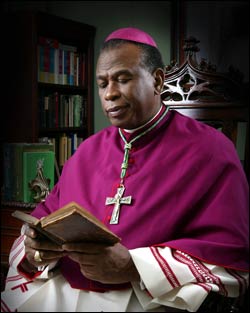
The future Bishop studied for the priesthood at Quigley Preparatory Seminary, Niles College Seminary and St. Mary of the Lake Seminary, Mundelein, Ill., in the Archdiocese of Chicago, where he earned his BA, MA, S.T.B. and S.T. L. degrees. He served as a deacon at St. Raymond De Penafort Parish in Mount Prospect, Ill., and spent his first year in the priesthood as Associate Pastor of Holy Name Cathedral. He was Associate Pastor of Sacred Heart Parish in Winnetka Ill., from 1971 1973. There he was deeply influenced by his Pastor, the renowned liturgist and pastoral pioneer, Msgr. Reynold Hillenbrand, one of the founders of the Christian Family Movement, which urged the Christian faithful to become genuinely involved in the life of the Church. He was a post-graduate student at the Catholic University of Louvain in Belgium from 1973 to 1975 where he earned a Ph.D. in Religious Studies and an S.T.D. in Systematic Theology summa cum laude. The focus of his studies was on the pastoral implication of the concepts of sacrament, myth, symbol, metaphor, and metaphysics in the theological methodology of the influential Jesuit theologian Bernard J.F. Lonergan and their relationship to the teachings of the Second Vatican Council. While at Louvain, he continued to do parish ministry at American military bases in Germany and at Our Lady of Mercy Parish, the American Parish in Brussels.
Returning to Chicago, Fr. Braxton served as Associate Pastor of St. Felicitas Parish on the south side while pursuing a Post Doctoral Fellowship with Fr. David Tracy, Langdon Gilkey and Mercia Eliade at the Divinity School of the University of Chicago. Krister Stendahl, the Dean of Harvard University Divinity School invited him to fill the William A. Coolidge Chair of Ecumenical Thought at Harvard from 1976 to 1977. While at Harvard he lived at Lowell House and did pastoral ministry at St. Paul’s Parish in Cambridge. The next year he was a visiting professor of theology at the University of Notre Dame. The future Bishop became Chancellor for Theological Affairs to Bishop James A. Hickey of Cleveland in 1978 at the request of the Apostolic Delegate, Belgian Archbishop Jean Jadot, who knew him from Louvain. He continued this work as Special Assistant for Theological Affairs when Bishop Hickey became the Archbishop (later Cardinal) of Washington DC in 1980. He served as the Cardinal's personal theologian, research assistant, and theological resource person for the Diocesan Curia.
He was one of the first priests to be appointed to this type of collaborative work with a bishop on a full-time basis. During this time, he lived at St. John the Baptist Church in Silver Spring, Md., where he was actively involved in parish ministry. He became the Scholar in Residence at the North American College, the U.S. Bishops’ seminary in Rome in 1983 at the recommendation of Cardinal Hickey.
When Bishop Braxton returned from Rome, Cardinal Bernardin appointed him to serve as the Director of Calvert House, the Catholic Student Center at the University of Chicago, from 1983 to 1986. He served as a peritus for the Symposium of Episcopal Conferences of Africa and Madagascar in Kinshasa, Zaire (now Congo) during the summer of 1984. In August of 1985 he addressed the 43rd International Eucharistic Congress in Nairobi, Kenya on the topic "The Eucharist and the Catholic Family."
When the late John Cardinal O'Connor convened the National Symposium On Black Catholics in New York in September of 1985, he invited the future Bishop Braxton to give the keynote address, "Black Catholics in America: Where Do We Go From Here?" (Later published in America.) In August 1986, he was one of five American priests selected to represent the priests of the United States at the International Symposium on the Priesthood sponsored by the National Federation of Priests' Councils in the United States, Canada, Australia, England and Wales. Priests from fifteen English-speaking countries around the world participated in the Symposium held in Chicago.
From 1986 to 1992 the Bishop worked full time as Official Theological Consultant to William H. Sadlier Inc., a New York based leading publisher in the field of Catholic Religious Education. He worked with the authors of all catechetical texts to ensure that they faithfully expressed the teachings of the Catholic Church while giving numerous presentations for Sadlier on the Catechism of the Catholic Church. His office was in the shadow of the World Trade Center where he knew people who perished in the terrible events of September 11, 2001. During his years in New York, he lived at St. Joseph's Church in Greenwich Village and at Notre Dame Parish on the campus of Columbia University and he was actively involved in the pastoral life of both parishes. Cardinal Bernardin called him back to Chicago and appointed him Pastor of St. Catherine of Siena Parish in August 1992. Shortly afterwards he was elected a member of the Senate of Priests of the Archdiocese.
Throughout his ministry the Bishop has frequently been invited to preach in major Catholic and Protestant pulpits, such as the National Shrine of the Immaculate Conception, St. Mary’s Cathedral, San Francisco, the Sage Memorial Chapel at Cornell University, The Memorial Church at Harvard University, and The Rockefeller Chapel at The University of Chicago. He has preached many retreats for priests, deacons, religious, and lay people around the United States, as well as in Canada, Central and South America, Europe and Africa. He has been the keynote speaker at many national Catholic gatherings, such as the National Catholic Education Association.
His writings on a wide range of theological and pastoral topics have appeared in the Harvard Theological Review, Theological Studies, Louvain Studies, The Irish Theological Quarterly, Chicago Studies, Origins, The New York Times, America, Commonweal, The National Catholic Reporter, U.S. Catholic, The Priest, The St. Louis Post-Dispatch, The Ligourian, The Lake Charles American Press and many other journals and periodicals. He is the author of numerous articles on African American Catholics, many of which have been translated and published abroad. His books The Wisdom Community and The Faith Community: One, Holy Catholic and Apostolic are widely used in Catholic colleges and seminaries. His professional associations include the American Academy of Religion, The Catholic Theological Society of America, The Canon Law Society of America and the Black Catholic Clergy Caucus. His profile is included in Who's Who in Black America and Who's Who in Midwest America. He is able to converse in French and he has a reading knowledge of Spanish and Italian.
Pope John Paul II appointed him Auxiliary Bishop of St. Louis on March 28, 1995. His Episcopal Ordination was on May 17, 1995, just days after the Silver Jubilee of his Priesthood Ordination (May 13, 1970) and his parents’ 55th wedding anniversary (May 5, 1940). One week after he became a bishop, May 23, 1995, his father, Cullen, died at age 80 in his Oak Park home. Only one and one-half years later (January 30, 1997), his only brother and his dearest friend, Cullen L. Braxton Jr., died of cancer. His personal, pastoral, and theological reflections on these profound losses in his life were published in a two-part essay, “Grief Observed: A Lenten Refection” in the March and April 1998 issues of The Priest.
As Auxiliary Bishop of St. Louis, Bishop Braxton served as Vicar General with pastoral responsibility for four Deaneries embracing dozens of parishes. Because the Archdiocese was in the midst of a Strategic Planning Program, the bishop was engaged in the difficult work of helping small city parishes to determine whether they should merge with neighboring parishes or close. He was the Archbishop’s representative to Catholic Hospitals and was actively involved in the discussions concerning the appropriateness of St. Louis (Jesuit) University selling its hospital to a for profit corporation, Tenet. He oversaw the ministry of the Permanent Deacons in the diocese. With over 215 deacons, St. Louis has one of the largest diaconate communities in the United States. He oversaw the work of restructuring and strengthening the Deacon Formation program.
He also oversaw the work of the Human Rights Office, which strives to apply the gospel of Jesus Christ, the teachings of the Vatican Council, and the Social teachings of the Popes to the specific challenges of justice and peace which people face every day. He was responsible for the work of evangelization in the Archdiocese as well. As coordinator of the work of Catholic Charities, the bishop was actively involved in the largest private social service program in Missouri. He also had a variety of responsibilities with Priests’ Personnel Board, the Archdiocesan Pastoral Council, The Archdiocesan Curia, The Kenrick-Glennon Seminary and the Archdiocesan Development Appeal. Every three months he hosted an informal gathering for all interested priests in the Archdiocese to discuss any topic in theology they found of interest.
Bishop Braxton was responsible for the erection of Wiktor Szostolo’s well-known sculpture, “The Angel of Harmony” next to the St. Louis Cathedral on Lindell Blvd. The face of the majestic angel with wings made of wind chimes is that of the Bishop’s brother, Lawrence. Children of different backgrounds play in harmony at the feet of the angel. On the base are Dr. Martin Luther King’s challenging words, “Love is the only force powerful enough to turn an enemy into a friend.” It has become a frequently photographed work of art is St. Louis’s Central West End.
As a member of the United States Conference of Catholic Bishops, the bishop is a past member the Administrative Committee, the committees on Education, Catechesis, Science and Human Values, the Permanent Diaconate, Doctrine, Liturgy, Scripture Translation, Implementing the Mandatum (Ex Corde Ecclesiae), and International Policy (Social Development and World Peace)—which took him to the Sudan. He has also served on the committees on Evangelization, Ecumenism, African-Americans, and the American College Seminary at the University of Louvain (Chairman). In November 2010 Bishop Braxton was elected to serve on the Administrative Committee as the representative of Region VII (Illinois, Wisconsin, and Indiana). At the same time he became a member of the Committee on Priorities and Plans, the Committee Liturgy, the Committee on Consecrated Life, while continuing to serve on the Committee for the Protection of Children and Young People. In May, 2011 Bishop Braxton was appointed Episcopal Liaison to the National Organization for Continuing Education of Roman Catholic Clergy (NOCERCC).
The Bishop was appointed Second Bishop of Lake Charles December 12, 2000 and installed February 22, 2001. He was actively and energetically involved in every aspect of the diocese. He made the ministry of bishop a visible reality not only in religious contexts but in educational, social, cultural and political contexts as well. In the wake of the terrible events of September 11, 2001 the bishop’s homilies, talks, and articles (“Is God on Our Side?” “We All Worship Allah”, “An Introduction to Islam”) had a very positive impact on the community.
On March 15, 2005, Bishop Braxton was appointed Eighth Bishop of Belleville. He was installed in the Cathedral of Saint Peter on June 22, 2005. When he began his episcopal ministry in Belleville, his mother, Evelyn, 85, was not able to be present because of her failing health. In the Diocese of Belleville, the Bishop has been actively engaged in every aspect of the ministry of the Diocese. He has given a particular emphasis to education and the work for vocations to the priesthood. He has composed a special Diocesan Prayer for Vocations which is prayed throughout the Diocese and which has been selected for publication by The Priest magazine (May, 2011). He regularly visits all of the elementary and secondary schools in the Dioceses and each year he provides in depth theological formation for all of the teachers. He has brought a significant number of missionary priests to the Diocese and he gathers them (along with the most recently ordained) for quarterly afternoons of prayer and theological reflection (‘the Wisdom Community”). The Bishop holds similar quarterly catechetical-formation meetings for the Permanent Deacons and their wives. In order to be present to all of the parishes outside of confirmations and major parish celebrations, the Bishop is in the midst of Parish Pastoral Visitations to all 117 parishes of the Diocese. In these Visitations, he spends the weekend at the parishes, celebrates the Masses, participates in a dialogue with the parishioners, meets with parish leaders, attends Parish School of Religion activities, visits those who are unable to come to Mass, meets with the Pastor, and learns about the local life of the parish. In a special ministry to the bereaved, the Bishop has established the custom of calling or writing every household in the Diocese when there is a death in the family. The Bishop’s own mother, Evelyn Braxton, died on February 10, 2008, one month before her 88th birthday.
In preparation for the celebration of the 125th anniversary of the erection of the Diocese, January 7, 2012, Bishop Braxton has invited all the priests, religious, and Christian Faithful to enter into a time of spiritual renewal. One component of this renewal is a diocesan-wide small group study of the United States Catholic Catechism for Adults (Fanning the Flame). At the same time he has called the entire Diocese to enter into a period of serious and prayerful examination of pastoral life, resources, and the needs of the future. In time, this review may lead to parish restructuring and reorganization in order to adjust pastoral structures to present-day realities. The Bishop is exploring the possibility of a Diocesan pilgrimage to the Holy Land as a conclusion to the 125th anniversary celebration.
In 2010, the Bishop celebrated the 40th anniversary of his ordination to the Priesthood (May 13th), the 15th anniversary of his ordination to the Episcopacy (May 17th), ant the 5th anniversary of his installation in Belleville (June 22nd). He celebrated these anniversaries in a special way in Rome at the concluding ceremonies of Pope Benedict XVI’s Year for Priests. The Bishop continues to address a variety of theological themes in his published writings including:
Ecclesiology: We Are His Witnesses: The Decline of Common Meaning in the Church
A Pastoral Letter for Pentecost 2006 – Diocese of Belleville
Published: June 4, 2006 Origins: August 3, 2006Religious Education: Catholic Education and the New Apologetics
Keynote Address to the National Catholic Educational Association
Presented: April 18, 2006 Origins: May 4, 2006Evangelization: Cross-Cultural Ministry: One Church in Two Different Worlds
Keynote Address to African Conference of Catholic Clergy and Religious in the United States
Presented: August 8, 2008 Origins: December 11, 2008Liturgy: The New Roman Missal: An Opportunity to Embrace, Not a Burden to be Endured
Published: The Priest, May 2011Bishop Braxton’s most recent publication is his Pastoral Letter: World Day of Peace 2015: The Racial Divide in the United States which has appeared in Origins, America, and The Tablet in London.
Bishop Braxton’s life and ministry as a bishop is integrated with a wide variety of interests. He is an avid reader of theology, philosophy, psychology, sociology, literature, and the arts. (He is especially interested in serious international films.) He has traveled extensively in Africa, Europe, Asia, North and South America. He enjoys a wide variety of music. He likes the outdoors: sailing, whale watching, hiking, skiing, and in line skating. He particularly enjoys the adventure of white water rafting on the Colorado River of the Grand Canyon.
Good spiritual direction is an essential component of his life. Each year he makes a silent retreat at Gethsemani, the Trappist Monastery in Kentucky. Two of the most important religious experiences in his life have been thirty-day directed Ignatian Retreats. The writings of St. John of the Cross, St. Francis DeSales, St. Catherine of Siena, Blessed John Henry Newman, Gerard Manley Hopkins, S.J., Thomas Merton, and Dr. Martin Luther King, Jr. have had a significant impact on him. Close contact with and genuine communication with his family and those dear bishops, priests, deacons, religious, and lay people who are “in his life for his life” are also important components of his interior world. In the card commemorating his 40th anniversary he wrote, “While there have been days in my life as a priest when I have been unhappy, there has never been a day that I was unhappy that I was a priest!”
-
Bishop's Coat of Arms
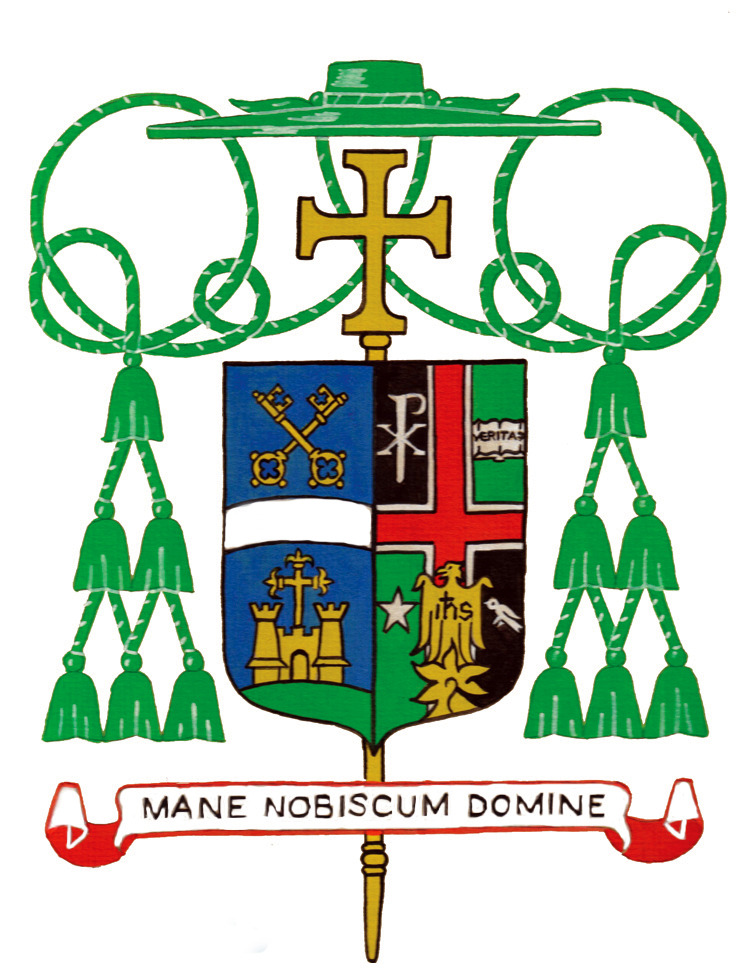
Many people today have images and symbols that are particularly meaningful to them and to their families. Perhaps this is the reason why some families are researching their genealogy and creating family symbols or seals which embody their history. Since the twelfth century, the tradition of personal symbols in a seal or coat of arms has been associated with Catholic Bishops. These Episcopal seals consist of a gold Episcopal processional cross, the traditional bishop¹s hat or gallero with its six green tassels on either side over a shield containing specific symbols. The symbols on the left side represent the diocese in which the Bishop serves. Those on the right are his personal and family symbols. The scroll under the shield contains the Bishop¹s personal motto.
The left side of Bishop Braxton¹s shield contains symbols of the Diocese of Belleville, Illinois in which he was installed as Eighth Bishop on June 22, 2005. Belleville is symbolized by a blue field with a green mount or hill rising from the base of the design. This hill has a dual significance. It refers to Compton Hill, the name of Belleville until 1814, and to Cahokia Mounds near which Bishop Laval of Quebec established the first mission serving the Cahokia Native Americans in 1699. On the top of the hill is a castle which is the traditional symbol for a city (³ville²). It is rendered in the precious color of gold for beauty (³belle²) which identifies the See City, Belleville. Rising above the castle is a gold cross with arms that end in fleur-de-lis to honor the French missionaries who served the Native Americans of Southern Illinois. Above the castle is an arched bar which is taken from the Coat of Arms of His Holiness, Pope Leo XIII who erected Belleville as a Diocese in 1887. Just above this bar are the symbolic ³keys to the Kingdom of Heaven² given by Christ to Simon Peter, the rock on which He built the Church. This is in recognition of the diocese¹s Cathedral Church of Saint Peter. The recognition of St. Peter holds special significance for Bishop Braxton. His confirmation name is Peter. He was appointed to Belleville during the last months of the pontificate of the 263rd Successor of St. Peter, Pope John Paul II, and he was installed during the first months of the pontificate of the 264th Successor of St. Peter, Pope Benedict XVI.
The right side of the shield contains personal symbols that Bishop Braxton used in his Coat of Arms as Auxiliary Bishop of St. Louis and on the right side of his Lake Charles Coat of Arms. The design recalls the Bishop¹s personal history, his family, especially his parents, Cullen and Evelyn Braxton, his diverse experiences as a priest and theologian, and his vision of his ministry as a bishop.
Bishop Braxton¹s personal insignia is inspired partly by the arms of the late Archbishop of Atlanta, James P. Lyke, O.F.M. (1939-1992), who was one of his dearest friends. The design is dominated by a red cross, which signifies Faith, the gift by which a person becomes a Christian. The cross is outlined in white or silver to signify that the Bishop was ordained to the episcopacy during his Silver Jubilee Year, on the twenty-fifth anniversary of his First Mass. The cross creates four quarters in the design. In the quarters are symbols of significant elements in the Bishop¹s ministry. In the upper left quarter is a silver Chi-Rho, the first two Greek letters of the word Christ. This Christ-centered symbol is taken from the arms of the His Eminence, Justin Cardinal Rigali, Archbishop of Philadelphia, who was Bishop Braxton¹s principal consecrator. The Chi-Rho also reminds him that everything he does should be in Christ. In the upper right quarter is an open book that bears the Latin word for truth, Veritas. The book is used to signify the Bishop¹s life as a scholar, writer, and theologian, especially his years as Personal Theologian to his mentor, His Eminence, James Cardinal Hickey, late Archbishop of Washington. The book is placed within the design opposite the Chi-Rho to stress that as a pastoral theologian Bishop Braxton¹s scholarship has always been in the service of the Church.
In the lower left quarter of the design is a star for Mary, Mother of the Lord, the Patroness of Saint Mary of the Lake Seminary, in Mundelein, Illinois, where Bishop Braxton studied and was ordained to the priesthood. She is also the Patroness of The Catholic University of Louvain in Belgium, where Bishop Braxton¹s critical formation as a theologian took place during his doctoral studies. The star also honors the late Pope John Paul II (in his devotion to Mary), who appointed him Auxiliary Bishop of St. Louis, Bishop of Lake Charles, and Bishop of Belleville. Opposite the star is a small bird, a martlet, taken from the coin of the realm of England at the time of Saint Edward, King and Confessor, and Bishop Braxton¹s baptismal patron.
Rising from the base of the shield is a gold phoenix, a bird coming forth from fire. The phoenix, charged with the IHS, the monogram of the Holy Name, is taken from the arms of the Archdiocese of Chicago. By the use of this symbol, the Bishop recalls the twenty-five years that he spent as a priest of the Archdiocese of Chicago and his work as a theological advisor and writer for the late Archbishop of Chicago, Joseph Cardinal Bernardin.
The background of the entire design is rendered in red, green and black. These traditional African colors represent his personal family, especially the Christian witness of his dear parents, Cullen and Evelyn Braxton. The colors also represent the larger African-American family and his appreciation of the peoples and the Church of Africa. Black stands for the rich soil of the South, once worked by the Bishop¹s brave ancestors brought low by the sin of human slavery. Black also celebrates the beautiful dark complexions of a proud people and the ³gift of Blackness² which Pope Paul VI declared was needed by the Church. Red represents redemption and liberty won for all by Christ and struggled for by those who shed their blood for freedom during slavery and amid the strife caused by the racism that endures in our own day. Green calls to mind the Hope nourished by Faith symbolized by the vibrant new life springing up in the Church in Africa and African-American communities.
With his appointment to Belleville, Bishop Braxton has changed his motto from Gaudium et Spes (Joy and Hope), the opening words of the Second Vatican Council¹s Pastoral Constitution on the Church in the Modern World to Mane Nobiscum Domine (³Stay with us, Lord²) the words of the disciples who encountered the risen Christ on the road to Emmaus (Lk. 24:29). This is also the title of John Paul II¹s Apostolic Letter designating 2004-2005, the year in which the Bishop was appointed to Belleville as the Year of the Eucharist. This gives expression to the centrality of the Mass and the Eucharist in his life.
- 1